All work WEB PLATFORM / SEO & AI VISIBILITY prototype

10  /  WEB PLATFORM / SEO & AI VISIBILITY

SEO Powerhouse

Search is splitting in two, and the usual toolkit says nothing about whether ChatGPT can read or cite a site.

May 2026FastAPINext.js 15PostgreSQL + pgvectorRedis + RQPlaywrightCloudflare WorkersOllama / Gemini / GroqDocker Compose

The challenge

Search is splitting in two. Classic on-page signals still matter, but a growing share of traffic now arrives through answers from ChatGPT, Claude, Perplexity and Google AI Overviews, and the usual toolkit says nothing about whether those systems can read a site, are allowed to crawl it, or ever mention it. I designed the platform to cover both halves as a paid product, with a tier ladder and Stripe billing planned from the start. Mid-build I changed the decision to free forever, and every paid dependency had to come out.

What I built

I built four services in one monorepo: a FastAPI backend, a separate Playwright crawler process, a Next.js 15 app, and a Cloudflare Worker fronting the public audit endpoint. The backend holds 55 classic SEO detectors and 35 AI-era ones, covering llms.txt validity, per-bot crawl policy for GPTBot, ClaudeBot and Google-Extended, LLM-oriented schema and E-E-A-T signals, each detector its own module behind a registry. Because I had kept every external provider behind an interface/mock/real/factory seam since the first commit, pulling the paid ones out was a swap rather than a rewrite: Claude and OpenAI became a tiered Ollama, Gemini, Groq and heuristic router, Voyage embeddings became local fastembed, SerpAPI became DuckDuckGo, DataForSEO became Common Crawl and OpenPageRank, and I neutered Stripe so the subscription lookup returns a synthetic free plan. One command brings the stack up with no keys at all, serving mock data inside the containers; run the backend directly, where `backend/.env` flips the `USE_MOCK_*` flags off, and the free providers take over.

How it works

NETWORK TIERS NEVER FAILS Ollama, if it is upa cached two-second probe Geminiif Ollama is not up Groqif Gemini falls through Deterministic tierno network, never raises every network tier catches its own exceptions, so it falls through rather than propagating The same rule, every free client embeddings to a hash vector, PageSpeed to local heuristics, search to empty
The mechanism, drawn from the build.

What it looks like

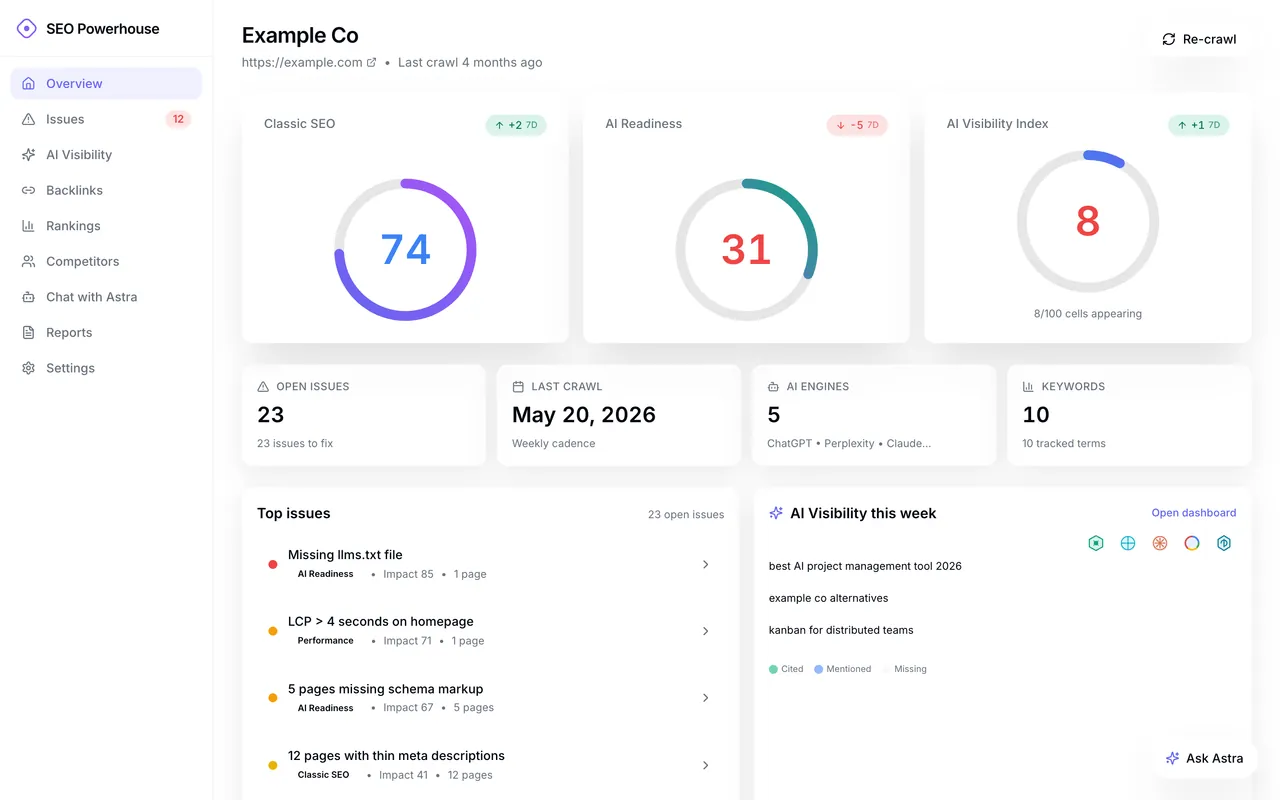
SEO Powerhouse — screenshot
Running locallyWEB PLATFORM / SEO & AI VISIBILITY

The detail

01

Tiered fallback

`llm_router.py` tries a locally running Ollama, then Gemini, then Groq, then a deterministic heuristic tier that never touches the network and never raises. A cached two-second probe decides whether Ollama is up, and every network tier catches its own exceptions so it falls through rather than propagating. I made the same rule mandatory for every free client: embeddings degrade to a hash vector, PageSpeed to local heuristics, search to empty.

02

A tenancy leak

I enforce tenant isolation with a SQLAlchemy `do_orm_execute` listener that injects `WHERE tenant_id = :tenant` for any model tagged `@tenant_scoped`. I had built the criteria with `lambda model_cls, t=tenant: ...`, and SQLAlchemy caches lambda statements without tracking default arguments, so the first request's tenant id was baked in permanently and every later tenant's queries filtered on it. I fixed it by capturing the tenant as a tracked closure variable; until then I had been papering over the symptom with `_bypass_tenancy=True` escape hatches.

03

Edge URL validation

I front the public `/grade` endpoint with a TypeScript Cloudflare Worker whose URL validator rejects non-http(s) schemes, private and loopback IP literals, reserved TLDs, userinfo credentials and oversized URLs. The file states plainly that edge validation is necessary but not sufficient, and that the backend must re-resolve the hostname at connect time to defend against DNS rebinding. I wrote the limit down rather than assume it away.

04

Labelled, not implied

Without paid engine APIs you cannot capture literal ChatGPT output, so I route all five engines through one free pipeline: live DuckDuckGo results fed to the free LLM with per-engine personas, every result labelled free-web-synthesis rather than dressed up as real engine output. Brand detection runs three layers, exact substring, then fuzzy match against canonical brand variants, then an LLM implicit-reference check only when the first two miss. I skip layer three deliberately for competitors, so cost stays flat however many a project tracks.

05

A dead flag

I declare `free_mode` once in `config.py` and read it nowhere, and my `docker-compose.yml` sets `FREE_MODE: "true"` on two services where it does nothing. It reads like the switch that turns the free stack on, and it is not one: inside the containers `backend/.env` is dockerignored and never copied, so the mock-on defaults win and the compose path serves fixtures. Real crawls need `CRAWLER_MODE` flipped off its mock default as well. A loose end I own.
The outcome

A working, self-hostable application rather than a plan. The frontend boots from the existing install, and every route I checked returned 200 with no backend, no database and no API keys: the marketing homepage, the free-audit flow, pricing, the five free tools, the project dashboard, AI visibility, issues, the Astra chat pane and sign-in. The repository holds 1,427 tracked files, with 806 test functions across 85 backend test modules, 78 frontend test files and 8 Playwright E2E specs, run against 565 recorded fixtures. I checked the detector counts in the docs against the source and they hold: 55 classic, 35 AI-era, 3 chatbot. I have never deployed it, so there are no usage or business figures behind it.